Showing posts with label Europe 2009. Show all posts

Monday, October 26, 2009

La House - our lifeline to the world

I think we have previously mentioned the cafe down the street owned and run by a Moroccan Swedish guy called Samir. This great little place quickly became our home away from home in Lodeve because of Samir's great personality, his generosity and hospitality and his delicious Tagine cooked food. He also provides free WiFi so La House was our contact point with the world outside of Lodeve.

Samir is a very interesting and likeable character. His family were political refugees from Morocco who settled in Stockholm, Sweden almost 30 years ago. He spent the first 15 years of his life in Morocco and the second 15 in Sweden. He is now just over 40 and identifies more as a Swede than a Moroccan. His parents and his 2 sisters have since moved back to Morocco, obviously no longer under threat. Samir is living in France to be nearer too his parents in case he is needed, but does not want to move back himself.

Samir playing with his much-loved "house" music
La House is very different than any other cafe or bar in Lodeve, which has added a much needed element to the hospitality scene in the town. We have got to know Samir well, and have tried to talk him into coming to Fremantle to open a bar/cafe with a Moroccan/Spanish theme. We reckon he would be a real hit in our town, and it is clear that he would like to come over. Let's see what happens. Interestingly he was all set to come to Perth a few years ago to study at Curtin but family matters intervened.

I had a great afternoon there yesterday, after dropping in on him as he was about to close the doors for the day. Of course he welcomed me in (as he always does). Gaye had decided to stay home and pack for our departure this morning, and she had foolishly said "stay as long as you like". Another new friend, Mimi Caruth- a young Irish woman who is in Lodeve studying French (language) and Buddhism. was there as well, hard at work on her laptop. I think I have mentioned previously that there is a major Buddhist Temple in the mountains just outside Lodeve, which attracts people from all over the planet. Anyway we opened beers all round, and I set up my laptop to do some email and blogging. Before I even got started Mimi and I got involved in a philosophical discussion, centred around Buddhism of course, that we continued for about 2 hours (and several beers). Samir tucked himself away in a corner with his house music to play with, until a couple of his local friends dropped in as well. Eventually, about 7pm (4 hours later) I managed to escape after only half completing my intended correspondence. A really pleasant end to our time in Lodeve.

This is Mimi


Au Revoir Lodeve (for now). We have had a wonderful holiday here, and have got to know the town so much better, and of course met a lot more people than on our last visit. It is starting to feel like a second home......and we WILL be back.
We are heading into Montpellier soon, where we will stay the night and then catch an early TVG train for Paris. Three nights in Paris, then a train to Zurich to board our Emirates flight home on Friday night. Back to work on Monday next week. Perhaps one more post to this blog from Paris.

Sunday, October 25, 2009

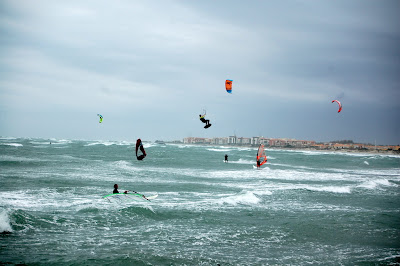
Agde - on the Mediterranean port

On Tuesday this week we went down to the Mediterranean coast a bit, in dodgy weather, to Agde which is less than an hours drive from Lodeve. It had started to rain in Lodeve and the forecast for the whole area was for 2-3 days continual rain. But when we got to Agde we were surprised to find it fine – very windy and quite threatening but it did not rain at all in the several hours we were there. Another example of the amazing luck we always have with weather when travelling (pity the luck doesn’t extend to the things financial!). The wind referred to is well illustrated in the following images taken at Cap D’Agde which is the more recently settled seaside (and resort ) settlement.

Agde is now very much a holiday destination, and in some of the more recently developed parts is a bit too reminiscent of the Gold Coast (but without the extreme high-rise buildings). As a resort it is apparently very popular with people who like to take their clothes off – it hosts the largest nudist resort in Europe. It is a very ancient, dating back to 550BC (or thereabouts) when it was first settled by the Phoenicians, and later became a major trading port for the Romans. The two millenniums since have seen the whole area silt up so that the original town of Agde is now 15kms inland.

Albi

Since we dropped B+J off in Montpellier last Saturday, from where they were catching a TGV to Paris, we have had three really interesting, and not too taxing days, visiting places we had not previously seen. On Sunday, after a leisurely start to an again stunning day (weather-wise) we headed for Albi which I thought was an hour or so NW of Lodeve. It turned out to be closer to 2 hours but that did not matter one little bit, as the drive was beautiful; though the region famous for Roquefort cheese.

Before we reached Albi we took a detour to a place called Ambialet, because we saw a sign depicting the village that looked interesting. This is something we do a lot, and always have when driving in France. Many of our favourite destinations are not mentioned in the popular guidebooks, but have been discovered by us in this way. In our mind it is essential to have a car in southern France, otherwise so much that is special would be practically inaccessible.
Ambialet is a very pretty little village, situated on an oxbow of the Tarn river. The centre of the town is located on a narrow spit of land, 25 metres across, at the narrowest point of the oxbow . This can be seen in one of the images below.

After a picnic morning tea by the river in Ambialet, we set off again for Albi, driving mostly along the course of the river. We were pleasantly surprised by Albi. It is a medium sized city of nearly 50,000 people, and is built on the Tarn river. Unlike most other towns and villages in Southern France the dominant building material is red brick (see images below). The bricks are only about one third of the thickness of a common Australian house-brick. This gives the town a relatively unique appearance as far as France goes.

Apart from the general appearance of the town (and its superb bridges over the Tarn), the highlights of our brief visit were the quite amazing baroque Cathedral of Ste-Cecile in the middle of the old town, the museum in the Palace de la Berbie dedicated to Toulouse Lautrec (a famous son of Albi), and the Lapeyrouse museum. For those familiar with Sydney, and Botany Bay in particular, you would recognize the name La Perouse (as it is used in Sydney). Lapeyrouse, another famous son of Albi, was three quarters of the way through an amazing voyage of discovery that would have challenged anything Captain Cook did, when his two ships (and all on board) were lost in the New Hebrides in 1788 (date sound familiar?). His last landfall was at Botany Bay at the location that now bears his name. The square outside of the museum in Albi is named Botany Bay, and there is a significant amount of reference to “New Holland” in the museum.


Saturday, October 17, 2009

Goodbye to Garry and Jan

Today (Wed 7/10) we said goodbye to my brother Garry, and his wife Jan, in Montpellier where they were catching a TGV (the very fast train) up to Paris and then home. They have just spent 6 days with us at the end of their first trip to Europe. They have had a fantastic adventure and I am sure will have caught the “travel bug” that Gaye and I have had for so long.
We had an action-packed few days with them. As the official driver, and unofficial guide, I was determined to show them as much as practically possible in the time of this amazing region, that we have grown to love so much.

A number of the places we visited were on our list of favourites, but we did have a few new experiences like the “Train Jeune” (Yelllow Train) which is an old train that travels a spectacular 45 km route through the Pyranees, on the French-Spanish border. Although it is a 2.5 hour drive, mostly on motorways, to connect with the train, it is well worth it.

After our experiences in showing Denis & Kit, and Garry & Jan around, we have come up with the crazy notion of hosting small groups (8-10) from Oz, giving them a highly personalized 14 day tour of Languedoc (our region), Provence and the Perigord-Dordogne. We believe that with a small group like this, able to travel in a small bus, our now quite extensive local knowledge of these regions would allow us to provide a far better experience than a more traditional tour operator could. Food for thought….and we are thinking about it. Perhaps the first tour in April 2011, who knows?

Saturday, October 10, 2009

Lodeve - our town - our apartment


We thought we should publish this short video clip to give you an idea of what our apartment in Lodeve looks like. Deb (our friend from Bize) has just spent a couple of days with us, and took this on her faithful little Canon digital.

For those of you familiar with Lodeve I will also post a few images of our rivers in flood which you may not have seen before. Last week we had 3 days of almost constant (and at times very heavy) rain after 5 months without any. The impact on the 2 rivers that encircle Lodeve was immediate and dramatic.


And I will finish this off with an shot of Lodeve from one of the surrounding hills.


Just a reminder that our apartment is available for short term rentals if you are thinking about visiting this beautiful part of the world.


Friday, October 9, 2009

A few facts + figures

For those who are numbers oriented, or who have asked questions about the price of things here in France, here are just a few answers.

We have had the car for 30 days as of today (Thursday 8th Oct)
We have driven more than 6800 kms in that time (an average of 230 kms per day).
On the motorways (“A” roads) where the speed limit is mostly 130 we average nearly 120 kms per hour of driving, however we mostly avoid these instead preferring the national (“N”) roads or Departmental (“D”) roads.
On the minor roads we struggle to average 55 kilometres per hour of driving, but we see and experience so much more.
Our car is a Peugeot 308SW diesel from which we get nearly 1000kms per tank of fuel (averaging nearly 20kms per litre.
We have paid between 0.91 and 1.15 euros per litre for diesel or “gazole”. Cheapest fuel is always at supermarkets while the most expensive is in the many roadside stops (“aires”) on the motorways.
Unleaded petrol ranges from 1.14 to about 1.30.

The all important wine purchases are very inexpensive. On average we are paying between 2.50 and 4.50 for a bottle of more than acceptable red or white from most supermarkets.
A decent bottle of champagne can be obtained for as little as 15 euros, while Moet is about 26. Cheap but quaffable Methode de Champenoise can cost as little as 4.50.
Alcohol generally is cheap in the supermarkets e.g. a bottle of gin from 6 euros, Baileys 10-11, Cointreau about 13 etc. A dozen small stubbies of beer (330ml) can cost less than 4 euros.

Most processed food items seem to be marked about the same as in Perth, but of course in euros rather than dollars so are therefore 50-70% dearer. Fruit & veges are cheaper and generally better. Soft drinks seem much more expensive than at home, but we never buy them so I am not sure. Really nice pastries of many kinds cost between about 0.60 and 2 euros.

Cheeses (Fromage) are probably cheaper than at home but it is difficult to do a direct comparison. The choice is mind-boggling. France is reputed to have more than 400 different styles of cheese, and our major supermarket seems to stock most of them.

The food staples are probably a bit cheaper e.g.
1 litre fresh milk 0.90
Bread A large baguette costs between 0.30 and 0.60
A dozen eggs From about 1.50

Accommodation is probably not that much different to Australia (with the notable exception of Paris). A room for two in a good Chambres d’Hote (B&B) will cost from 45-65 euros. Two or three star hotels are in the range 50-75 euros with breakfast extra (usually 7-10 euros each).

Entrance fees to museums and other places of interest are generally cheap by European standards (much cheaper than our previous experiences in the UK). We have paid between 3 and about 9 euros for various places.

Some things are ridiculously cheap but usually for a good (often environmental) reason e.g. as mentioned before we can park our car all day in a parking station at the end of a tram line in Montpellier (medium sized city), and get a return tram ticket for every person in the vehicle into the centre of the city (1/2 hour journey), for only 4 euros. And in Montpellier we can rent a good quality bike for just 1 euro per day.

Music CD's and Movie DVD's are more expensive than at home. CD's cost between 20 and 30 euros, while DVD's look to be in the 20-35 euro range.
Hardware (of the Bunnings kind) seems very expensive e.g. a small pair of pliers will cost 12-15 euros. The cheap Chinese imports do not seem to have made it here.

Hope this helps you appreciate the cost of living in France.

Thursday, October 8, 2009

Spain - San Sebastien

After a very pleasant day and a half in Bilbao we headed back to San Sebastien, a place we have long wanted to visit. The drive back was interesting to say the least. We decided to avoid the motorway on the return journey as time was not an issue, but I underestimated the need for a map. We had actually driven to Spain without a Spanish road map (or a GPS) – not a challenge if you use the motorways and can read the ample signage – but get on the N and D roads, amongst the frequent little villages, and you quickly reminded why maps were invented. We were also thrown of the scent by the names San Sebastien and Donostia being used interchangeably. What our limited reading had not told us is that the Basque name for San Sebastien is Donostia. Once we had worked that out, and circumnavigated many roundabouts multiple times while we assessed the correct exit, we finally made it into SS The next challenge was finding the pension we had booked, which we knew was in the Parte Vieja or “old town” and that it was highly unlikely we could get the car anywhere close. Somehow we did get close (without realizing it), decided to stop and ask directions at a little bookshop, after parking illegally. After a bit of fun with the shop owner, and his customer who both got involved, it turned out we were only 100m from our destination, so my homing instinct had worked again.
The pension, Lonely Planets “authors choice”, was in the oldest building in San Sebastien. It was quaint but certainly no more than 1 star. A tiny bedroom with a bed about 25cm too short for me, so my feet hung out over the end while sleeping, and a shared bathroom. However the mattress was OK, the sheets clean, no-one else was using the bathroom that we did, and it was superbly located, so for just a 2 night stay Lonely Planet did not really let us down.

San Sebastien is stunningly beautiful seaside city of just under 200,000 inhabitants, built around 2 large bays, one with a narrow entrance guarded by a small island, surrounded by mountains and divided roughly in half by a picturesque river, the Rio Urumea. Its 3 famous “playas” or beaches are reminiscent of several Sydney beaches including Bondi. Since the 19th century it has been a favourite summer destination for the Spanish elite, including the royal family we are told. Its character is enhanced by the existence of an active fishing fleet that ties up very close to the old town. Lots of similarities with Fremantle, just more geographically spectacular. In fact on one of our many walks I was waxing lyrical about SS and said to Gaye “I could easily live in a place like this” – she said “you do” - I said “you’re right”….and she was!

SS is also renowned as the culinary capital of Spain, if not Europe, with more Michelin stars per head of population than any other city in the world, and a concentration of tapas bars in the old town greater than any other in Spain, and that is saying something. Needless to say our time in SS was dominated by much walking, with frequent interruptions for pintxos, beer and txacoli (the traditional Basque wine). The tapas here are actually pintxos, the Basque version of tapas, with bread playing a dominant role. Every establishment displays its pintxos on uncovered plates set out along the bar, with typically 20-30 different choices. Usually the customer is given a plate and walks along selecting the pintxos they want, order a drink and then part with their money. The pintxos very in price from about 1.5 – 3.5 euros each, a small beer 2 and a large beer about 3.5. It is actually a very unhygienic process that our over-zealous public health authorities would never allow in Oz.

We believe this fabulous city would appeal to anybody and everybody we know, and have no hesitation in saying “add it to your European itinerary” (and don’t forget Bilbao while you are here).

Some images of San Sebastien for your enjoyment:


The magnificent Guggenheim Museum


A modern wonder of the world.